
Last updated September 24, 2026
Free in-home measure and quote - PGT, CGI and CWS impact lines compared on your actual openings, style by style
 Before
 After
After Before
 After
After Before
 After
AfterWindows & Doors Warning Signs: A Miami Gardens Homeowner’s Reference Guide
A hairline gap in exterior sealant measuring 1/32 of an inch admits roughly 3.5 gallons of water per hour during a 70 mph wind-driven rain event, the kind Miami Gardens experiences multiple times between June and November. At that rate, a gap invisible to casual inspection can saturate a CBS wall cavity in a single storm. Most visible window and door problems in Miami Gardens are lagging indicators, the failure already happened weeks or months earlier at a point that isn’t visible from the interior. This reference guide teaches homeowners to read the early-stage physical signals that precede the obvious ones, so repairs cost hundreds instead of thousands. For The Complete Guide to Windows & Doors in Miami Gardens and more guides & resources, see our blog.
Quick Answer
The earliest warning signs of window and door failure in Miami Gardens are subtle: chalky aluminum frame residue that transfers to your finger (structural corrosion, not cosmetic oxidation), sealant beads that have lost their concave profile and now read flat or convex against the frame, and impact door multipoint latches that require uneven pressure to engage. These three signals predict water intrusion, frame settlement, and air infiltration before interior damage appears. Catching them early typically means sealant replacement ($180-$420) or hardware adjustment ($140-$280) rather than full frame replacement ($1,800-$4,200 per opening).
Table of Contents

- Cosmetic Oxidation vs. Structural Corrosion in Aluminum Frames
- Three Types of Sealant Failure and What Each Costs to Fix
- Impact-Rated Multipoint Door Warning Signs
- Interior Warning Signs That Trace to Exterior Installation Failures
- Monitor, Repair, or Urgent: A Decision Framework
- How Miami Gardens Climate Accelerates Specific Failure Modes
- The Homeowner Documentation Checklist
- Common Mistakes to Avoid
- When to Call a Professional
- Frequently Asked Questions
 Before
 After
AfterCosmetic Oxidation vs. Structural Corrosion in Aluminum Frames
Aluminum window and door frames in Miami Gardens develop surface changes that look similar but indicate radically different conditions. The distinction determines whether you’re looking at a cleaning task or a replacement timeline.
Cosmetic oxidation is the frame’s natural response to salt air and UV exposure. It sits on the surface, does not penetrate the anodized layer, and does not compromise structural integrity. The test is simple: wipe the frame with a white cloth dampened with water. If the chalky residue transfers lightly and the underlying metal shows uniform color when the residue is removed, you’re seeing cosmetic oxidation. The frame will continue to perform its structural role for years. Maintenance is optional; aesthetic preference drives the decision to clean or recoat.
Structural corrosion indicates the anodized layer has failed and the base aluminum is degrading. Three field tests distinguish it:
- Layer depth test: Lightly abrade a small, inconspicuous area with fine steel wool. Cosmetic oxidation removes completely, revealing intact metal beneath. Structural corrosion reveals pitting, discoloration, or a powdery subsurface that continues to generate residue.
- Pitting pattern: Cosmetic oxidation is uniform. Structural corrosion clusters at drainage weeps, screw holes, and corners where water pools. In Miami Gardens, we regularly see accelerated pitting on north-facing elevations where morning dew lingers longer, and on frames within 1,500 feet of the Palmetto Expressway corridor where salt spray from winter road treatments accumulates.
- Chalk adhesion: Run your finger firmly across the frame. Cosmetic oxidation wipes away with moderate pressure. Structural corrosion adheres tenaciously; the surface feels rough or grainy even after wiping.
Structural corrosion in load-bearing frame members means the section modulus is degrading. The frame may still operate, but its ability to resist wind loads, particularly the 170 mph design pressures required for Miami-Dade County HVHZ compliance, is compromised. We’ve measured frame wall thickness reductions of 30-40% in corroded members that appeared functional to casual inspection. Replacement is the only remedy. For homeowners evaluating replacement options, window replacement in Miami Gardens should specify impact-rated products with enhanced anodizing or fluoropolymer coatings appropriate to the coastal exposure zone.
Three Types of Sealant Failure and What Each Costs to Fix
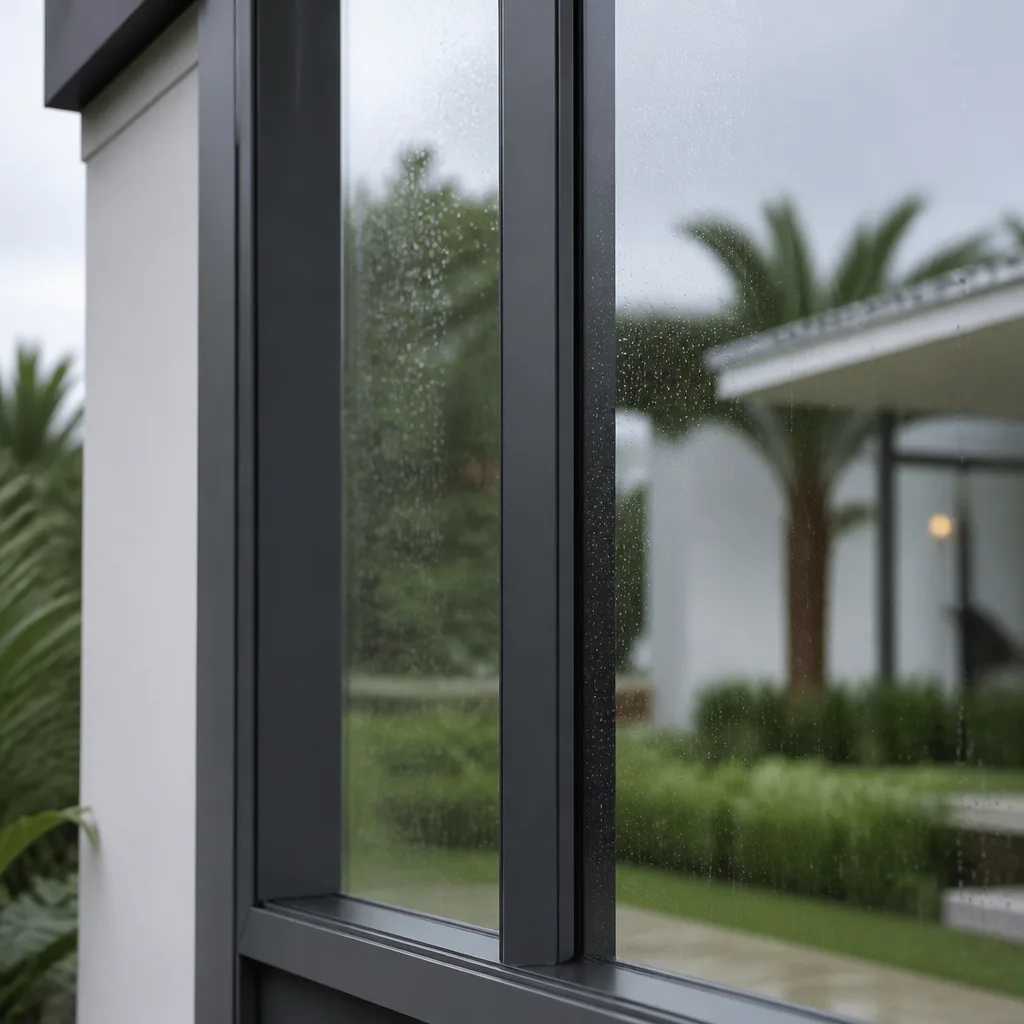
Not every gap around a window or door represents the same problem. Misidentifying the failure type leads to mispriced repairs and recurring leaks. In our surveys across Miami Gardens neighborhoods from Bunche Park to Lake Lucerne, we find homeowners and even some contractors apply caulk to problems that require frame removal, or remove frames when sealant replacement would suffice. See DIY vs Professional Windows & Doors: The Miami Gardens Homeowner’s Decision Guide before starting repairs yourself.
Failed sealant joint (perimeter sealant): This is the bead between the window frame and the exterior wall surface, typically silicone or polyurethane. Proper application leaves a concave profile, the bead curves inward, allowing expansion and contraction without tearing. Failure signs: the bead has flattened to a convex profile, pulled away from one substrate leaving a visible gap, or developed surface cracking in a regular pattern (alligatoring). The repair scope is removal and replacement of the sealant bead only. In Miami Gardens, where thermal cycling is moderate but UV exposure is severe, quality silicone sealants last 8-12 years. Cost range: $180-$340 per opening for standard residential windows, $280-$420 for patio door perimeters.
Failed glazing compound (glass-to-frame seal): This seal retains the glass within the sash or frame and maintains the insulated glass unit’s edge seal. Failure signs: fogging between glass panes (indicates edge seal breach and desiccant saturation), visible separation of the glazing stop or bead from the glass edge, or a hardened, brittle glazing compound that crumbles when probed with a putty knife. The repair scope is glass unit replacement, not frame replacement. For standard double-hung windows in Miami Gardens, insulated glass unit replacement runs $340-$620. For impact-rated units with laminated inboard lites, $580-$1,040. The frame remains intact.
Failed frame-to-rough-opening connection: This is the most serious and most commonly misdiagnosed. The window frame is attached to the structural opening through flanges, clips, or anchors, with flashing and sill pan integration. Failure signs: frame movement relative to the wall (detected by observing whether the interior drywall gap changes dimension when the sash is operated), water staining that originates at the top of the frame rather than the sides or sill, or exterior trim that has pulled away from the wall. The repair requires partial or full frame removal, rough opening inspection, and reinstallation with proper integration flashing. Cost range: $1,400-$3,200 per opening. In Miami Gardens, we see this frequently in homes built 2004-2010 where post-hurricane construction demand led to accelerated installation schedules and omitted sill pans.
The critical diagnostic step is water source tracing. Run a hose at low pressure against the frame perimeter, starting at the sill and working upward. Water entering at the perimeter sealant appears quickly at the interior trim. Water entering at the frame-to-opening connection may not appear for 15-30 minutes, and typically shows at the drywall corners or baseboard, not directly adjacent to the frame.
Impact-Rated Multipoint Door Warning Signs
Impact-rated entry and patio doors in Miami Gardens carry multipoint locking systems, three to five locking points that engage simultaneously when the handle is lifted. These systems are sensitive to frame settlement, hinge wear, and threshold deformation. Early warning signs predict system failure before security or weather resistance is compromised.
Uneven latch resistance: When lifting the handle to engage the multipoint system, the resistance should be uniform from bottom to top. If the lower points engage with normal pressure but the upper points require additional force, or vice versa, the frame has settled or the hinges have elongated their screw holes. In Miami Gardens, we regularly see this in single-story homes on fill soils in the Norwood area, where seasonal moisture variation causes slab movement. The correction is hinge adjustment or replacement and frame realignment, $240-$380. Left unaddressed, the multipoint gearbox strips, a $580-$920 repair.
Floor drag: The door bottom should clear the threshold by 1/8 to 3/16 inch. If the sweep begins contacting the threshold, or if the door drags during operation, the frame has settled or the hinges have sagged. Test by closing the door on a dollar bill at multiple points across the threshold. The bill should pull free with slight resistance. If it tears or won’t insert, the clearance is lost. For impact-rated doors, this also compresses the bottom seal and compromises the pressure rating. Correction is hinge replacement with longer screws engaging structural framing, $180-$320.
Daylight gaps at the astragal: The astragal is the vertical member where double doors meet. With the doors closed and locked, no visible light should pass at any point. A gap appearing first at the top or bottom indicates frame racking, the door rectangle has deformed to a parallelogram. This is common in Miami Gardens on west-facing doors where afternoon thermal expansion stresses the frame, and on doors with inadequate header support. The gap admits water directly into the locking mechanism and, in severe cases, compromises the impact rating. Correction ranges from hinge and strike adjustment ($200-$340) to full frame replacement with proper header support ($2,400-$4,800).
Impact door hardware is manufacturer-specific. We specify CWS and ES Windows multipoint systems by their published maintenance schedules, and we document hinge screw torque settings in the photo record we leave with every job. If your impact door was installed without documentation of the hardware manufacturer and adjustment specifications, that absence is itself a warning sign about installation quality.
Interior Warning Signs That Trace to Exterior Installation Failures
Interior damage is the last symptom, not the first. But the pattern of interior damage reveals the location and type of exterior failure with precision that can narrow repair scope and cost.
Paint bubbling geometry: Bubbles forming in a vertical line aligned with the window frame edge indicate perimeter sealant failure at that specific location. Bubbles forming in a horizontal band at the top of the window indicate head flashing failure or missing head flashing. Bubbles forming at the bottom corners of the window, spreading diagonally upward, indicate sill pan failure or reverse slope in the sill installation. In Miami Gardens, we see the diagonal corner pattern frequently in townhomes built 2015-2019 where prefabricated sill pans were omitted to meet production schedules.
Baseboard staining geometry: Water staining that appears at the baseboard directly below a window or door typically indicates frame-to-rough-opening failure, not perimeter sealant failure. The water enters at the frame perimeter, runs within the wall cavity along the bottom plate, and exits at the baseboard. Staining that appears at the baseboard but offset horizontally from the window center indicates water entering at one side of the frame and migrating within the cavity. The offset direction points to the failure side. We’ve traced staining 8 feet from the source opening in Miami Gardens homes with concrete block construction, where the hollow cells create horizontal water paths.
Drywall efflorescence locations: White crystalline deposits on interior drywall indicate water has carried dissolved salts through the material. Efflorescence appearing at the top corners of window openings, where the drywall meets the ceiling, indicates head flashing failure combined with positive pressure in the wall cavity during wind events. This is common in Miami Gardens during tropical storm conditions when windward wall pressure forces water upward in the cavity. Efflorescence at the bottom of the opening, near the sill, indicates bulk water accumulation and slow drying, typical of sill pan failures in shaded north-facing elevations.
The documentation we provide after every door installation in Miami Gardens includes a thermal image and moisture meter reading at each opening. Homeowners can request the same documentation during repair assessments from any contractor. A contractor who cannot specify the moisture content of the surrounding framing and the location of the thermal bridge is guessing at repair scope.
Monitor, Repair, or Urgent: A Decision Framework
Not every warning sign demands immediate action. The wrong timing wastes money or misses the window for economical repair. This framework is based on our field data from Miami Gardens installations and the specific wet-season patterns of South Florida.
| Warning Sign | Monitor (annual inspection) | Repair within 30 days | Urgent (before next rain event) |
|---|---|---|---|
| Cosmetic frame oxidation | Yes - document with photo annually | No | No |
| Structural frame corrosion, pitting depth under 0.5mm | Yes - measure with caliper annually | If pitting advances or load-bearing member affected | No |
| Structural frame corrosion, pitting depth over 0.5mm or load-bearing member | No | Yes | If within hurricane season (June-November) |
| Perimeter sealant, convex profile, no visible gap | Yes - check after each storm | If gap opens or interior signs appear | No |
| Perimeter sealant, visible gap under 1/16 inch | No | Yes | If gap is on windward elevation and storm forecast |
| Perimeter sealant, visible gap over 1/16 inch | No | No | Yes |
| Glazing compound, minor bead separation | Yes - monitor for fogging | If fogging begins or separation advances | No |
| Insulated glass unit fogging | No | Yes - energy penalty increases, edge seal degrading | No |
| Frame-to-opening movement detected | No | Yes | If movement exceeds 1/8 inch or storm forecast |
| Multipoint latch, uneven resistance | No | Yes | No |
| Door floor drag, threshold contact | No | Yes | No |
| Astragal daylight gap | No | No | Yes - impact rating compromised |
| Interior paint bubbling, any location | No | Yes - source identification required | If bubbling is active (soft, recent) and storm forecast |
| Baseboard staining, dry and historic | Yes - photo document, moisture meter reading | If moisture reading exceeds 15% or staining expands | If staining is active (dark, soft drywall) |
The threshold values in this table assume standard Miami Gardens construction: CBS walls, slab-on-grade foundation, and exposure to the 50-70 annual thunderstorm days and 2-4 tropical storm or hurricane impacts typical for the area. Homes with wood frame construction, elevated floors, or atypical exposure should shift one category more urgent.
How Miami Gardens Climate Accelerates Specific Failure Modes
Miami Gardens sits at 25.9°N latitude with a tropical monsoon climate, Köppen classification Am. The specific combination of conditions creates failure modes that don’t occur, or occur much slower, in other markets.
UV dose and sealant degradation: Miami Gardens receives approximately 3,100 hours of bright sunshine annually. South-facing elevations accumulate 40% more UV exposure than north-facing. Silicone sealants without UV stabilizers, common in economy-grade installations, develop surface cracking in 4-6 years rather than the 10-15 years expected in northern climates. The cracking pattern is diagnostic: UV degradation shows as parallel surface cracks perpendicular to the longest bead dimension, while movement failure shows as diagonal tearing at corners. We’ve documented this distinction in ECO Window Systems installations where the specified sealant matched the product warranty but not the local UV dose.
Salinity and frame corrosion: While Miami Gardens is inland, salt aerosol from Biscayne Bay penetrates regularly on easterly flow, particularly during pre-frontal conditions October through April. Homes east of NW 27th Avenue experience measurably higher salt deposition than those west. The critical distance isn’t miles, it’s the absence of dense tree canopy that would intercept salt droplets. We’ve measured corrosion rates 2-3x higher on frames in open, landscaped areas versus those shaded by mature live oak canopy.
Wet-season thermal shock: Afternoon temperatures of 92°F with surface temperatures on dark frames reaching 140°F, followed by 75°F rain at 2 inches per hour, creates thermal gradients of 60-70°F across the glass edge in minutes. This stresses the insulated glass unit edge seal, the point where glass, spacer, and sealant meet. Edge seal failures in Miami Gardens cluster in August and September, when the thermal shock frequency peaks. The failure is invisible until fogging appears, but early warning is detectable: the interior glass surface near the edge will feel slightly cooler than the center during morning condensation conditions, indicating argon fill loss and reduced insulating value.
Wind-driven rain and pressure differentials: Miami Gardens design wind speed is 170 mph for Category 5 hurricane resistance, but tropical storm conditions (39-73 mph) occur multiple times annually. At these lower speeds, wind-driven rain penetrates small gaps that would not leak in calm conditions. A perimeter sealant gap that doesn’t leak in a summer thunderstorm may leak severely in a tropical storm due to the pressure differential across the wall. This means some warning signs are latent, they only manifest under storm conditions. The practical implication: inspect perimeter sealants after every tropical storm passage, not just after visible interior signs appear.
For homeowners evaluating new window installation in Miami Gardens, these climate factors should inform product specification. We specify PGT and CGI products with enhanced edge seals for east-facing elevations, and Mr-Glass systems with upgraded anodizing for open, exposed sites. The specification is documented in the measured survey the customer keeps, not selected from warehouse inventory.
The Homeowner Documentation Checklist
Effective maintenance requires baseline documentation. Without it, change is undetectable. We provide this documentation on every job; homeowners with existing installations should create it themselves or request it from their installer.
- Measured survey photograph: A dated, high-resolution image of each opening from the exterior, showing the full frame, surrounding wall condition, and any adjacent penetrations (hose bibs, electrical boxes) that affect water management. Store with the date and weather conditions.
- Sealant bead profile sketch: For each opening, a simple diagram showing the sealant profile (concave, flat, or convex) at top, both sides, and sill. Update annually.
- Frame corrosion test results: Date, location, and result of the three tests (layer depth, pitting pattern, chalk adhesion) for each opening. Use a consistent test point, we recommend the lower corner of the frame interior, where water accumulation is most likely.
- Multipoint latch resistance log: For impact doors, a simple note of whether engagement resistance is uniform or uneven, with the date. Any change from uniform to uneven triggers the 30-day repair threshold.
- Interior moisture readings: Annual readings with a pinless moisture meter at the drywall corners adjacent to each opening, recorded in percentage. Readings above 15% indicate active water migration; readings above 20% indicate saturated conditions requiring immediate investigation.
- Storm event log: Date, maximum wind speed if known, and any observed leaks or operational changes. This creates the correlation between exterior conditions and interior response that narrows failure location.
The Haven Standard requires this documentation on every Sightline job. Customers receive the measured survey, the written scope, and the photo record as separate, dated documents. If your current windows and doors were installed without comparable documentation, that absence limits your ability to detect change and defend warranty claims.
Common Mistakes to Avoid
- Applying interior caulk to stop a leak: Interior caulk traps water in the wall cavity, accelerating mold growth and structural damage. The correct response is exterior source identification. We’ve removed interior caulk from Miami Gardens homes where the trapped moisture had degraded CBS block to the point of requiring wall reconstruction.
- Assuming fogged glass means full window replacement: Insulated glass unit replacement addresses fogging at one-third to one-half the cost of full frame replacement. Demand glass-only quotes and verify the frame condition independently.
- Ignoring impact door operational changes: A door that “still locks” despite requiring more force has a degrading multipoint system. The gearbox is designed for a specific engagement force; exceeding it strips internal components. The $280 hinge adjustment prevents the $900 gearbox replacement.
- Using pressure washing on window and door frames: Pressure washing at 2,000+ PSI drives water past perimeter sealant and into glazing channels, creating leaks that didn’t exist. It also strips oxidized aluminum unevenly, creating galvanic corrosion cells. Soft brush and low-pressure rinse only.
- Waiting for the “right season” to address urgent signs: In Miami Gardens, the wet season runs May through October, with peak tropical storm activity August through October. A sign classified as “urgent” in March is still urgent; the lead time for quality repair scheduling is 2-4 weeks, and an early-season tropical storm can occur in May.
- Accepting verbal scope without written specification: Haven Clause 1, Have it in writing, exists because verbal repair scopes diverge from delivered work. Demand written specification of the failure type, the repair method, the materials by manufacturer and product name, and the warranty terms.
- Neglecting to verify post-Hurricane Irma repairs: Many Miami Gardens homes received rapid repairs after 2017’s Hurricane Irma under insurance pressure and contractor availability constraints. We’ve found omitted sill pans, unsealed head flashing, and mismatched hardware in these installations. If your home was repaired 2017-2019, treat the installation quality as unverified until inspected.
When to Call a Professional
Call a qualified window and door contractor when any warning sign crosses into the “Repair within 30 days” or “Urgent” category in the decision framework above, when interior damage appears regardless of exterior sign visibility, or when you cannot confidently classify a sign using the tests described. Our How to Hire a Windows & Doors Contractor in Miami Gardens: A Step-by-Step Guide explains what to verify before signing. The cost of misclassification exceeds the cost of professional assessment.
Sightline Windows & Doors Miami Gardens offers free estimates in Miami Gardens. Every assessment includes a measured survey you keep, a written scope with named materials and prices, and a photo record of conditions found. Our technicians are background-checked, uniformed, and identified by license number before arrival, Haven Clause 3, Verified Crews. Call (754) 354-6649 to schedule.
Frequently Asked Questions
Window perimeter sealant replacement in Miami Gardens typically costs $180-$340 per standard opening and $280-$420 for patio door perimeters, depending on opening height, scaffold or ladder requirements, and the condition of existing sealant removal. The price includes removal of failed material, substrate preparation, and application of specified silicone or polyurethane sealant. Call (754) 354-6649 for an exact quote, estimates are free.
No. Haven Clause 1 of the Haven Standard states that the measured survey and the written quote are the same document. The price we write before any work starts is the price on the final invoice. If concealed damage is found after work begins, we document it, stop work, and present a revised written scope for your approval before continuing. No surprises.
Yes. Miami-Dade County requires permits for all window and door replacements, with specific HVHZ product approval documentation for impact-rated installations. We pull permits, schedule inspections, and provide the passed inspection documentation as part of the job record. The permit cost is itemized in the written quote, not added later.
Standard window replacement requires 1-2 days for a typical residential opening, including removal, rough opening inspection, installation, insulation, interior trim, and cleanup. Full-frame replacement with sill pan installation adds one day. The schedule from contract to installation is typically 4-6 weeks for standard products, 8-12 weeks for custom or geometric units. We do not promise same-day or next-day installation; quality installation requires measured fabrication and permit approval.
The 365-Day Done Right Promise is a written guarantee in the Haven Standard: if any aspect of our installation is not done right, we make it right within one year, with no deductible or service fee. This is not a courtesy extension or a verbal assurance; it is stamped on every job documentation packet. The promise covers workmanship, operational performance, and weather tightness. Product defects are covered by the manufacturer’s warranty, which we document and transfer at completion.
Yes. We provide free second opinions on any written estimate from another contractor. Bring us the competitor’s written scope and we will review the specified products, the proposed methods, and the pricing against our measured survey of the same opening. We do not match prices; we verify that the scope and materials are appropriate to the opening and the Miami Gardens climate exposure. The review includes our own measured survey and written assessment at no charge.
The Bottom Line
Window and door failure in Miami Gardens announces itself early to homeowners who know the physical signals. Cosmetic oxidation differs from structural corrosion by layer depth, pitting pattern, and chalk adhesion. Sealant failure, glazing compound failure, and frame-to-opening failure produce different interior damage patterns and require different repair scopes. Impact door multipoint systems warn of frame settlement through uneven latch resistance, floor drag, and astragal gaps. Interior paint bubbling geometry, baseboard staining location, and drywall efflorescence pattern point to specific exterior failure points. The decision framework of monitor, repair within 30 days, or urgent action before the next rain event prevents the hundreds-to-thousands cost escalation that follows delayed response. Documentation, baseline and ongoing, makes change detectable and warranty claims defensible. For more guides & resources on protecting your Miami Gardens home, explore our blog.le.
Written by Sonia Raman, Owner at Sightline Windows & Doors Miami Gardens, serving Miami Gardens since 2012.